

Lake Kerkini
About This Project
Lake Kerkini is suitable for alternative tourism and is one of the most important wetlands in Greece. In this very important biological complex lives, develops and reproduces in number and variety, a rich world of living organisms, a biocoenosis, whose protection and preservation for moral, aesthetic, scientific and economic reasons is of vital importance.
Lake Kerkini is located 45 km west of the city of Serres and next to the village of Lithotopos. Its name was borrowed from the lake Kerkinitis mentioned by Arrian, where the fleet of Alexander the Great was stationed. The current artificial Lake Kerkini was created in the place of the swamp of "Boutkovo", which most researchers of the historical geography of Eastern Macedonia identify with the ancient lake Prasiada. The river Strymonas, which was worshipped as a god in antiquity for the rich gifts of its waters to the plain of Serres, but also for its destructive power when it flooded, enters Greece, coming from Bulgaria, through the straits of Rupel and, before it merges its contents with the waters of the Strymonic Gulf, it rests in Lake Kerkini, the creation of which had the purpose of controlling floods, retaining sediments and irrigating the plain of Serres.
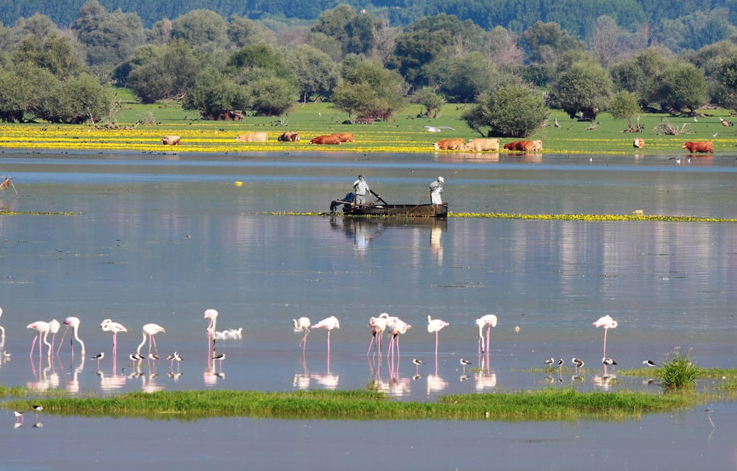
The creation of this artificial water reservoir favoured the development of a biocenosis of plant and animal species in a wetland of rare beauty protected by the Ramsar Convention, Greek Legislation and EEC Directive 79/409. The riparian forest provides refuge for 276 recorded bird species, which constitute 68% of the species found in our country, 70 of which, being rare or endangered, such as the Dalmatian pelican, the great white pelican, the ferruginous duck, the night heron, the spoonbill, the glossy ibis, the black stork and all the egrets, are considered protected by the European Union.
The relatively shallow lake, for most of the year, combined with the ecosystems of the Kerkini (Beles) and Mavrovouni (Kroussia) mountain ranges, whose peaks are reflected in its waters, favour the development of high biological productivity, which is enhanced by the nutrients carried into the lake by the Strymonas River. The combination of the three elements – vegetation diversity, water, and fertile soil – creates a significant number of habitats in the area that differ in their structure and functionality. In spring, as the lake floods, the forest of willows, tamarisk, plane trees, elms, and poplars provides a very important breeding and nesting area for water birds, while the impressive carpet of water lilies, covering almost 7 sq. km, offers an excellent refuge for fish. In the wet meadows with rich marsh vegetation, herons, spoonbills, and curlews find abundant food, while in the shallower waters, Salvinia and water chestnuts abound, excellent food for the lake's water birds. In winter, when the lake's water level drops, the composition of the birdlife changes, but its diversity remains high.
In the waters of the lake there are more than thirty species of fish, such as carp (grubfish), eel, butterfly, bullhead, etc., while on its borders lives a significant number of different amphibian, reptile and invertebrate species. On the edges of the riparian forest lives the largest number of buffaloes in Greece. In the wider area, which borders the lake, live many mammals, such as the jackal, wolf, wildcat, hare, fox, weasel, roe deer, badger, etc. Today, the abundance of food in the lake waters, its geographical location, the diversity of its habitats and vegetation contribute to this wetland being a very important environment for the development of ornithofauna, which finds ideal living and breeding conditions here, while the lake itself covers enormous ecological and economic requirements.