

Archaeological Site of Philippi
About This Project
The ancient city of Philippi was founded on the edge of the marshes that covered the southeastern part of the Drama plain. The city of Philippi is the most important archaeological site in Eastern Macedonia.
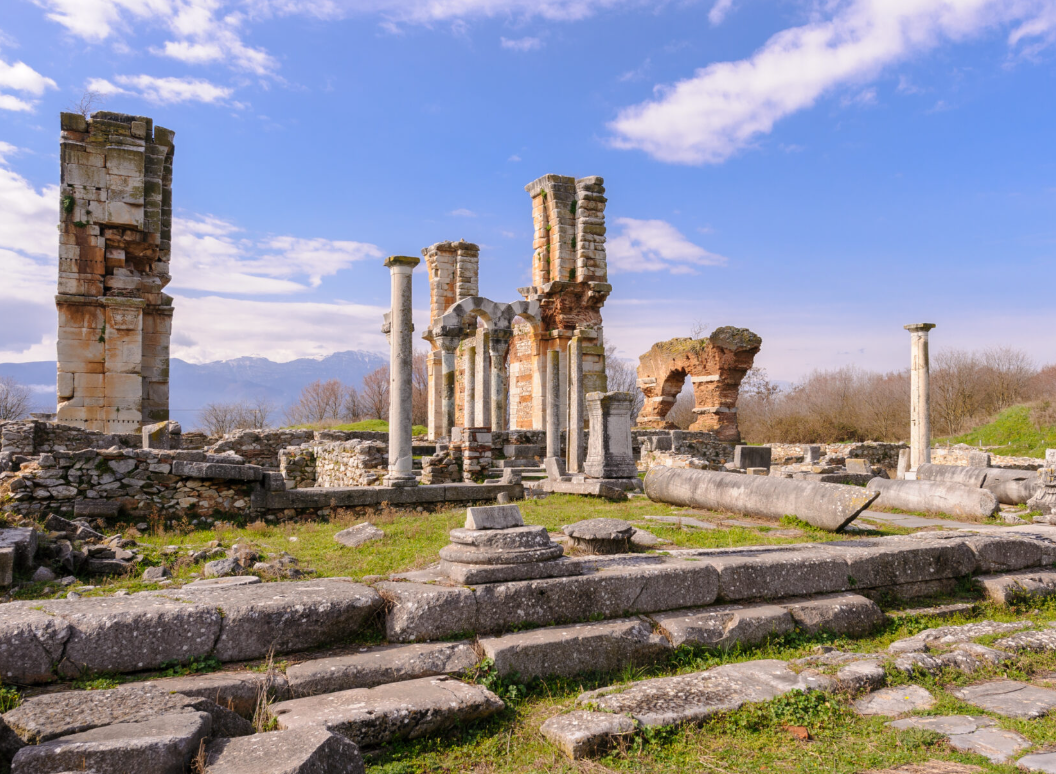
Today, visitors arrive at the archaeological site of Philippi, west of the Municipal Community of Krinides, following the provincial road of Kavala-Drama. The most important monuments and archaeological complexes of the archaeological site are: The walls and the acropolis, the theatre, the agora, "Basilica A", "Basilica B", and an octagonal church.
The walls start from the top of the hill, where the fortified acropolis is located, and enclose its foothills and a part of the plain (first phase - Philip II - mid-4th century BC, second phase – Justinian I, 527-565 AD). Inside the acropolis, there is a tower from the late Byzantine period. The total perimeter of the walls reaches 3.5 km.
The theatre was probably built by King Philip II around the mid-4th century BC. In the 2nd and 3rd centuries AD, significant changes and additions were made to adapt its function to the needs of Roman-era spectacles.
The Roman agora (forum) was the administrative centre of Philippi in the Roman era. It is a uniformly designed complex of public buildings organised around a central square with monumental structures, the northeastern and northwestern temple. To the north of the agora runs a large paved road that has been identified with the ancient Via Egnatia.
The basilica A' dates to around the end of the 5th century AD. It is a large, three-aisled basilica measuring 130x50m, with a transept on the east side, a square atrium, a gallery above the aisles and the narthex, and a unique baptistery. Sections of the luxurious paving and part of the ambo are preserved in the central aisle. The frescoes (imitation marble inlay) of the chapel antechamber are particularly impressive.
The basilica B' dates to around 550 AD. It is a three-aisled basilica with a narthex and annexes to the north and south (baptistery, diaconicon). The almost square central aisle was covered by a dome, which was supported by large piers. The sanctuary apse was covered by a dome. Its sculptural decoration reflects Constantinopolitan influence.
The "Octagon" was the complete complex of the episcopal church of Philippi. It includes the octagonal church, which shows three construction phases (from the late 4th/early 5th to the mid-6th century AD) and was built on the site of a prayer house dedicated to Apostle Paul (early 4th century AD). This house, in turn, had been founded on the site of a late Hellenistic tomb-heroön. The complex also includes a baptistery, a baptismal font, a bathhouse, a two-story bishop's residence, and a monumental pylon towards the Via Egnatia. Its vegetation contributes to this wetland being a very important environment for the development of ornithofauna, which finds ideal living and breeding conditions here, while the lake itself covers ecological and economic requirements of enormous importance.